Saturday, 24 October 2020

Let it Snow, Let It Snow, Let it Snow Bunting

 After a relatively quiet day at Druridge, Sam and I spent some time watching a very confiding Snow Bunting at a regular winter haunt for this species at the mouth of Chevington Burn.  We were so focussed upon the bird that it wasn’t until we stood up to leave that we saw that the bright skies of earlier in the day were now heavy with leaden grey cloud which darkened to a metallic purple  towards the south.  A minute spray of rain was in the air by now as the burn ran quietly to the incoming rush of the tide. Later, as we travelled homewards the light dimmed and heavy rain fell.

Snow Bunting

The Snow Bunting was feeding amongst the seaweed before hunkering down for some time. A stance that we were sure it would be used too in biting Arctic winds.  Fully aware of our presence it seemed relaxed enough.  It eventually took off and flew north above the shore although I suspect it didn’t go far and it could well be joined by others of the species. 


Snow Bunting

We have watched Snow Buntings in breeding plumage on Tundra and in snow in the Arctic Circle in recent years, but always nice to see these birds locally, but sadly not in the numbers of years gone by.


Snow Bunting

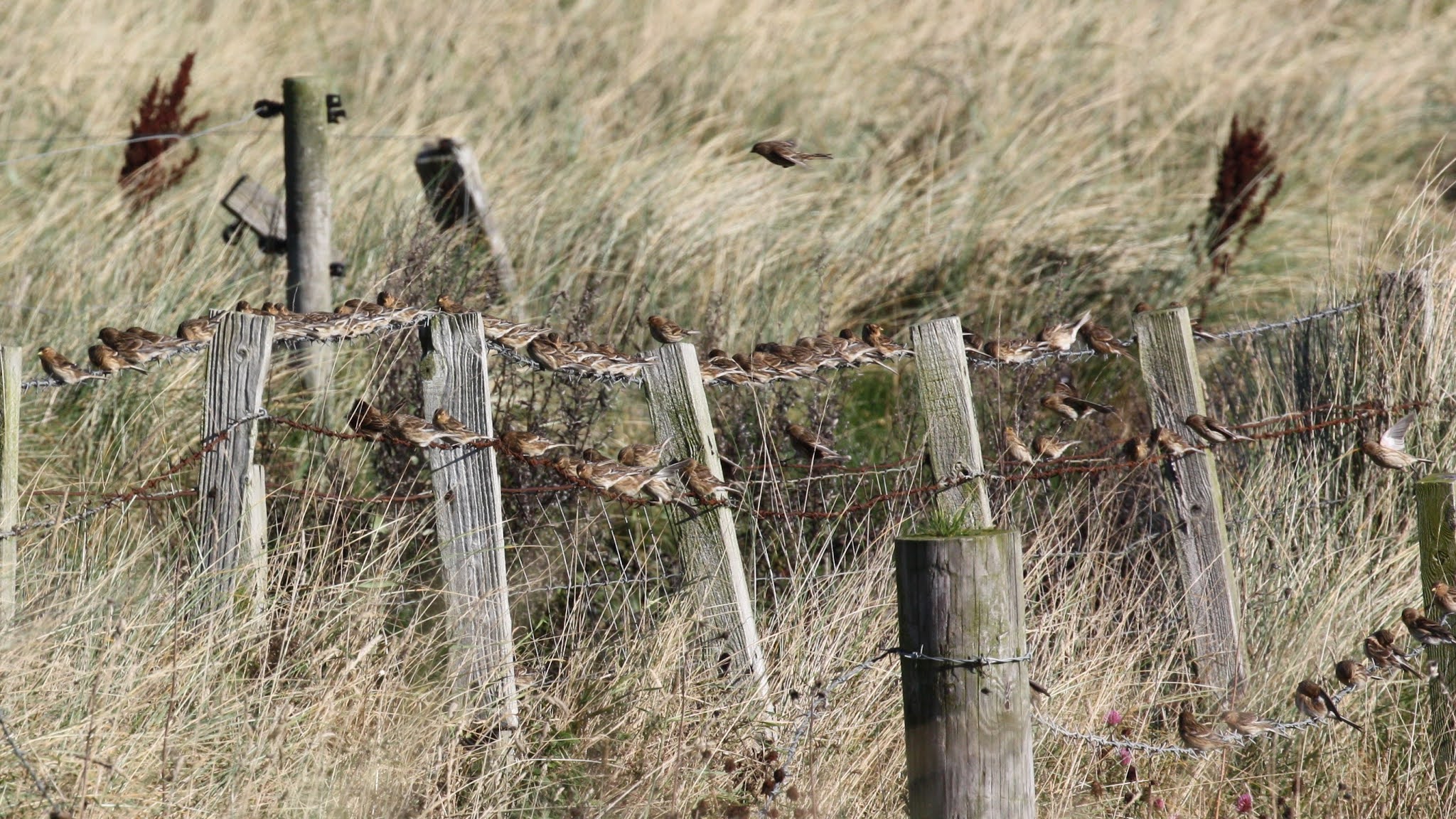
We had earlier watched at close range a flock of 60-80 Twite as they fed on the ample seed on plants in the dunes between bouts of flight, with then a background of sunlit blue skies.  Such was their attention to the glut of seed, these Twite were content to let us within close range.  Linnet, Goldfinch, Reed bunting and Tree Sparrow also seemed to be taking advantage of the feeding opportunity.


Twite

Walking through the dunes I was surprised at how late some Bloody Cranesbill and Harebell were in flower as were less surprisingly White Campions.  We also came across a patch of snow-white Fungi, one of which was in pristine state and most attractive in the bright light.  I’ve yet to check on species.

Campion

One of a number of White Fungi

A theme of white continued when we found two Whooper Swans at Druridge Pool.  We latter watched them take off and we began to ponder upon where these wild swans would eventually end their journey.  Perhaps not the first wintering swans seen this autumn as we passed a flock of swans which we passed at a distance when crossing the causeway at Holy Island earlier in the month.  We were on the move and distance prevented confirmation, but thought them likely to be Whooper Swans.

Whooper Swans

But now they drift on the still water,

Mysterious, beautiful;

Among what rushes will they build,

By what lake's edge or pool

Delight men's eyes when I awake some day

To find they have flown away?

Wild Swans at Coole/William Butler Yeats


Wednesday, 7 October 2020

Lindisfarne Classic Includes Red-flanked Bluetail

As we once again drove over the causeway to Lindisfarne and passed the flock of Brent Geese that were remarkably close to the road, we dared dream of a good autumnal fall of birds to greet us.  We were not to be disappointed.

Redstart

A stop was made at the Snook and the first bird to greet us was a cooperative feeding Redstart in the carpark.  Was this to augur a good day?  Our walk to the cottage plantation and garden was to be rewarded by a fine Red flanked Bluetail showing extremely well.  Only the second one I have seen in Northumberland.  On reflection not quite up to the standard of the sighting we made of this species in breeding plumage in the forests of Finland, but certainly closer and proving to be our bird of the day.  The plantation and garden provided quite a spectacular bird display and species seen here also included Blackcap, Willow Warbler, Chiffchaff, Song Thrush, Redwing, Blackbird, a flock of Linnets, Skylark, Meadow Pipit and more Goldcrest and Robins than you could shake a stick at.  Our wander around the area suggested there were Goldcrests and Robins to be found in almost every bush.  I also remember a Common Snipe.

Redstart

Red-flanked Bluetail

After parking up on the island, we made through the village to the Vicarage Garden which was being watched by numerous birders.  The first bird I saw in the garden was Spotted Flycatcher.  Even better, the Red Breasted Flycatcher also showed well eventually, and was a lifer for Sam.  A bird he has long coveted on his list.  Brambling and Yellow Browed Warbler were also seen, these latter two species perhaps both reaching double figures as seen and heard species by the time we had left the island.  By now we had also watched a large skein of Barnacle Geese and the large flock of Golden Plover in the air.   At one point someone mentioned that the Little bunting had returned and there was a mass exodus of fast-moving birders.  We decided to be more nonchalant about it all and eventually made off in the opposite direction to the herd and even stopped for a drink and piece of cake in the village having passed more Brambling, and calling Yellow Browed Warblers and of course the ever present Goldcrests and Robins.

We were soon on the lonnen watching Redwings and our first Fieldfares of the autumn.  Even better was sighting of two Redstarts along the base of the hedge.  Everyone else seemed to have only Lesser Grey Shrike on their mind and were hurrying along the lonnen in chase, so we had these Redstarts to ourselves.  We took it more slowly and watched Merlin and Short Eared Owl as we ambled along.  We still had sighting of the Lesser Grey Shrike, if a somewhat distant view.  This was a UK first for both of us.  Still the Goldcrests and Robins kept on coming.  A family of Stonechats were on the bushes as we chatted to another birder keen to find the shrike as it would be his first ever shrike of any of the species. 

Redwing

We followed the path that we had taken on our visit to the island a couple of days before, when there had been no sign of a fall of migrant birds.  We had sighting of a family of Roe Deer who appeared to have little fear of our presence.  We had eaten our lunch by the Lime Kiln remains, some birders seeming to wonder why we weren’t up there trying to find the shrike.  Most seemed to find the bird but few seemed to get anything but a distant sighting.  The Carline Thistle didn’t look quite so good after the soaking of the previous day.  As we moved from the area we had a nice sighting of a female Great Spotted Woodpecker, as mentioned in my previous blog, an irregular bird on the island.  Kestrel was seen at some point and both Grey Heron and Reed Bunting were seen nearby.

Roe Deer

We eventually made a return to the Vicarage Garden and ended our visit with even better sightings of Red Breasted Flycatcher and Yellow Browed Warbler once again.  We made off from the island in plenty of time to beat the incoming tide, and once again passed the Little Egret feeding near the causeway.  Pink footed Geese were seen as we drove down the AI.

We didn’t see all the rarer birds involved in the autumnal fall, but we did thoroughly enjoy the hours we had spent on the island and in the main, the species we did see (and we saw most of them), we saw very well.  I know neither of us would have enjoyed the time had we chased after birds to increase our list, as that is simply not our style.  We enjoyed talking to many fellow birders today, all enjoying themselves in the manner that suits them.  I must give special mention to the lady who lives in the cottage on the Snook as we had an enjoyable and long chat with her and she made us and other birders feel welcome.  Also, a special mention is owed to the friendly couple from Craster who approached me and said, ‘you must be Brian?’  My first thought was, good grief what have I done? Ha ha.  I needn’t have worried as they were regular readers of my blog and had recognised Sam.  We will simply have to live with the fame I suppose.

Hope everyone had as good a day as we did.  The first bird I saw on the lawn when I arrived home was a Robin and I believe Sam saw Goldcrest!  Classic Day.

ALL IMAGES COURTESY OF SAMUEL HOOD.

Monday, 5 October 2020

Brents, Bramblings, Berries and Bluethroat at Boulmer

 We were up before the larks and watched a flaming sunrise as we headed north to Lindisfarne hoping we would be one of the first cars to cross the causeway, and that proved to be the case.  As we drove over to the island we watched the brightly lit sky and water.  It was going to be a fresh but sunny autumnal morning.  Jokes were made about the vehicle in front of us being the one out of the TV programme Vera.  The lady driver did indeed have the Vera hat on and confirmation that it was in fact ‘her’ was made when we passed the film crew.  I was tempted to ask for a photograph when Vera parked opposite us in the carpark, but I thought better of it as she seemed to be engaged on some kind of communication system with the film crew.

Lindisfarne Light

Having walked through silent village we watched a growing flock of Brent Geese, a large flock of Golden Plover and of course the laid out Grey Seals which gave out a few mournful calls during the morning.  The vicarage garden brought nothing but a Robin, but Redwings were heard over head and a Great Spotted Woodpecker was seen in the air.  We thought this would be a rarity for the island and it was confirmed later, by a regular island birder that the woodpecker is not even recoded annually here.  Two Brambling were found in the trees opposite the church and as I purchased a Cappuccino Sam found us a few more Brambling in the centre of the village.  A Chiffchaff was heard at some point.  Red Admiral Butterflies were making the most of the sun despite the cold air.  The atmosphere was good with the occasional sound of Grey Seals, Curlew, Golden Plover, Oystercatcher, Knot and other waders.  Unlike on our previous visit when the sea was calm, we could hear the rushing waves along the shores of the island today.

The lonnen was now aflush with berries but held few birds, but at the far end Willows we had sightings of Treecreeper and Yellow Browed Warbler.  A nicely coloured Speckled Wood Butterfly was well camouflaged as it took heat from the sun.   Instead of completing our regular circular walk past the lough we walked through the dunes in the opposite direction which would eventually take us back to the road and carpark.  There was a sparsity of birds but numbers of Meadow Pipits and Skylark passed overhead and one of the latter singing above the fields.  We also had a nice sighting of a female Sparrowhawk.  A Kestrel was also seen at some point.

Speckled Wood seeking warmth

Caterpillar of Garden Tiger Moth

I was pleased to see that there was still plenty of Grass of Parnassus in flower even if not at its best.  I had the macro lens at hand on this occasion.  Also, as we passed by what appeared to be the remains of old lime kiln workings we found lots of Carline Thistle benefiting from the calcareous ground.  A small specimen of Viper Buglos remained in flower close by.   This little area would to our minds be a good spot to explore for plants come next spring and summer.  A nice patch of Sea Aster was also passed.  Also found were some ‘Woolly Bears’ caterpillars of the Garden Tiger Moth.  I was carful not to touch them as I had learned that they can cause serious skin irritation in some people.


Grass of Parnassus

Viper's Buglos still attracting bees.

The Snook car park was taken over by the film crew’s vehicles but we found a space elsewhere and had a walk through the dunes before making off in the Direction of Budle Bay.  The film crew were in action and we resisted the temptation of trying to get in on the act.  Little Egret was seen as we left the island.

TV crew at work

Carline Thistle

Sea Aster

The highlight at Budle Bay for me was the numbers of skeins of Pink Footed Geese, their calls unmistakeable, flying across the bay and seeming to make inland to the fields.  Geese are one of the real joys of this time of year and I can think of nothing better than being surrounded by them.  Two more Little Egrets were seen along with the likes of Curlew, Black   tailed and Bar Tailed Godwits and parties of gulls and Shelduck.

Edges of Budle Bay

As we passed by Boulmer we thought it worth checking out for the Bluethroat and we were rewarded with an excellent sighting of this bird feeding not far from the carpark.  It kept to the ground except when disturbed by a dog at which point it flew onto the nearby bushes before returning to feed again.  Boulmer has been kind to us in the past two weeks.  A good ending to the day.  Cloud building up and a drop in temperatures suggested a change in the weather once again.

Bluethroat image courtesy of Samuel Hood

I missed out on the fall of migrants that occurred during the heavy downpours of the following day, although Sam braved the weather and was well rewarded.  Thankfully, another trip to Lindisfarne today made up for my missing out and eased the envy.  Details of this fantastic day of birding coming soon.

Friday, 2 October 2020

Buttermere and Back

 This was a long planned visited to Buttermere, an area that I love, and it was to be a first time visit for Sam.  I had learned a great deal about Dumfries and Galloway from Sam and I was hoping to reciprocate in a small way today with an introduction to the area and the sharing of some tales and memories.  It was never meant to be a birding trip.

We’d certainly chosen an appropriate day for the experience as it was dry and sunny and the air was warming up as we left home early morning and travelled westwards.  The road taken was to include Alston and Hartside Pass where we hoped to stop to take photographs.  I’d almost forgotten how wild, rugged and picturesque this area is, although I’m sure many would point out that there is no true ‘wild’ about the place.  The Tyne Valley held dispersing patches of mist, some simply wisps, which were quickly burning off.  As we reached Hartside Pass the mist was thickening again, all the more as we gained height, so photography was forgotten, but as we descended we enjoyed the drive above a cloud inversion which was a real spectacular experience.

Blencathra.  AKA Saddleback

In the past I’ve spent many a time in Lakeland waiting for the mist to clear from the tops of the fells, but I need not have worried today as by the time we were past Penrith and looking up to the clear cut peaks of Blencathra we were under  blue skies with only patches of white cloud.  We chatted about my conquest of Blencathra quite a few years ago, not an easy climb even then.  We avoided the centre of Keswick but not without discussing the ‘Pencil Factory’, home of the first pencil, and the plumbago mine that once existed in a partially wooded and verdant Borrowdale, the area we next travelled through.   We stopped for a short time at Ashness Bridge for photographs and I was a little disappointed because I recalled a far better view in years gone by.  Perhaps the trees have grown and blocked some of the vista, or perhaps my memory is playing tricks.  Anyhow, we found out right away there is barely anywhere in Lakeland where you can park these days without paying!  We decided not to drive further up the narrow road to the hamlet of Watendlath, but to save that for another time.  I was reminded of Hugh Walpole’s dramatic descriptions of Borrowdale, and Watendlath in particular, in his Herries Chronicles.

Ashness Bridge with Skiddaw in background

Next stop was at the Bowder Stone car park, another episode of daylight robbery for parking.  This little episode will now be forever known to us as the Bowder Stone debacle.  I won’t go into details, but next time we’ll actually find it and not be sent heading in the wrong direction by a friendly lady attempting to help!  Has someone moved it since my last visit?  Borrowdale is a beautiful valley and memories came flooding back for me.  I pointed out Seathwaite to Sam and explained that it holds the distinction of being the wettest part of England. We were soon passing Seatoller and heading up Honister Pass.

Honister Pass

Honister Cragg

Honister Pass

Honister Pass

We parked at the top of Honister to enjoy the views and visit the quarry shop.  Honister Quarry is the last slate quarry to operate in England and has done so since the seventeenth century.  The underground workings have expanded further and further underground.  I got my eye on a slate wall clock which I have since ordered, so the stop in that sense was costly.  A walk to slightly higher ground gives a good opportunity for photography of the pass and craggs above, and Sam got his eye on patches of Butterwort in a typical wet habitat.  A search for Sundew brought no reward.  A Red Admiral Butterfly made an appearance as did a small butterfly that I thought may have been Mountain Ringlet known to frequent the high ground of Fleetwith, but having checked the dates of flight periods it seems most unlikely.  That brief sighting remains an unknown. Two Pied Wagtails flew across the carpark.

Honister towards Buttermere

Sam takes in the Honister atmosphere.

Honister

Honister

We found all parking spaces taken at Gatesgarth, which lies at the foot of Honister, so we decided to double back and take lunch in one of the pull-ins on the pass.  We agreed that this was a good decision as we sat enjoying our food in this rugged area with light patterns constantly changing across the steep fellsides and ahead of us over Buttermere.  It is little wonder that the poets and artists have been attracted to the area over many years.  The beck ran calmly and quietly.  It was giving off a typical sound of slow shallow running water that soothes the mind, whilst the rocks and pebbles showed shape, texture and colour through the pellucid cooling waters.  In places it held small still pools which took on a darker hue.  This was beginning to be Lakeland at its best, beautifully rugged and without droves of people, we only had the Herdwick sheep as company and a lone cyclist who was heading over the pass.

Wanscale Bottom

Wanscale Bottom and Haystacks

Wanscale Bottom

Wanscale Bottom

Eventually, having found a spot to park at Gatesgarth we set off to walk into Wanscale Bottom, taking a small bouquet of red roses to place at the point where my parents ashes were laid.  We took a few minutes out here, alone and with our own thoughts.  My mother and father loved this area and referred to it as the basin.  Understandably, as the surrounding fells including Fleetwith and Haystacks stand tall and encircle the area forming a basin like area.  The sun was now hot on our faces and the light shone brightly through the stand of trees.  The steep narrow waterfall at the head of the valley could be heard in the silent still air.  First of all, a Kestrel hovered above us and then a Common Buzzard hunted close by us in eagle like fashion.  I hopefully entertained Sam with tales of backpacking over Honister Pass and over the fells in my youth and some other tales.  Sam pointed out that a few of them ended in gloomy fashion and death, I suppose reflecting upon how dangerous the area can be.  We saw only two or three walkers in this quiet area far away from the touristy honeypots.

As we passed by Gatesgarth Farm and the cottage where I celebrated my twenty-first birthday I could help but feel some of the welcoming warmth had disappeared from the farm, not helped by the fact that the main drive way has now been gated and the gate was closed.  I told Sam of some of the characters of past years such as Annie Nelson an elderly lady and friend of Beatrice Potter who lived in the cottage when I began to visit the farm in the 1960s, Peter the painter who lived in the barn and completed many oil paintings of Lakeland scenes and sold them to visitors, and Jobby the farmer’s brother who my family always thought was the double of Hoss in the TV series of the time, Bonanza.

Gatesgarth and Buttermere

Buttermere Lake was as still as a village pond.  I remembered that on days as sunny and calm as this the reflections on the lake at early light and before any disturbance of the mere and sharp colourful and stunning.  Sadly, the Buttermere pines look unhealthy these days.  There had not been a breath of wind during our visit.  We drove along the narrow road to Crummock Water passing the small church at Buttermere of which William Wordsworth said ‘A man must be very unsensible who would not be touched at the sight of the chapel of Buttermere’.  There is a memorial here to Alfred Wainwright whose ashes are scattered on what were his favourite fells, The Haystacks which can be viewed from the church.  I’m not sure what Alfred or William Wordsworth would make of some of the traffic in Lakeland these days.

We returned to Buttermere Village and headed over Newlands pass.  If Honister Pass can be described as wild and rugged, Newlands is in stark contrast being more green, tamed and picturesque.  It was time to head for home now via Keswick and Penrith and onward along the Military Road.  We stopped near to Hadrian’s Wall for refreshment and noticed that already mist was beginning to form again in the valley.

It had been a great adventure and I was pleased to be able to share so many memories during the day with Sam.  Thanks mate.


Friday, 25 September 2020

Northumbrian Adventures in the Sun

The Indian summer days of mid-September have seen Sam and I visiting some well-known habitats in Northumberland.  Allen Banks is perhaps frequented more by birders in spring and early summer but we enjoyed a warm September day in clear autumnal light and felt no less rewarded for doing so despite the lack of flycatchers and warblers.  Amongst the rewards were a pair of Kingfishers showing briefly and well two or three times across the river, calling Dipper and a pair of Grey Wagtail fly catching, three species always associated with the river habitat.  Chiffchaff and Nuthatch were amongst birds calling from the trees.  Prior to our arrival we had watched garden birds, gathering Swallows preparing for southerly migration, Common Buzzard and male Sparrowhawk being mobbed by Swallows as we sat and drank coffee in my brother’s garden near Hadrian’s Wall country. Happily oblivious to forthcoming Corvid restrictions about to hit us once again.  I brought home a bag full of apples, newly fallen from one of the apple tree’s in the garden.


It wasn’t only apple tree we took an interest in today as we took notice of many of the tree species we passed, many old, broad and interesting.  The reflections on the surface of the river were mirrored sharply and stunningly and the rock outcrops of the gorge rising above the River Allen give a feeling of karst areas we had in the past become familiar with in central Europe.  A Common Buzzard was heard mewing somewhere in the clear sky above the steepest of the outcrops.  In the more shaded areas the ferns, a Hard Fern stood out as different especially, and the Great Horsetails standing tall gave a primordial feel to the place.  We sat by the river edge for a time just taking in the beauty of this area and enjoying the sun on our faces.

Great Horsetail

Another day was spent closer to home down at Brier Dene, South Bay and St Mary’s Island.  On our arrival the calm glimmering North Sea was lit by a rising sun which gave that Mediterranean feel to the place.  Today the morning began in typical autumnal style, bright and cold, although the sun soon warmed the air as the morning progressed and by the time we had finished in Brier Dene we were taking layers of clothing off.  The dene presented me with a wonderful sighting of a Kingfisher which lifted from the side of the burn as I approached, perched for a few seconds whilst my brain and eyes kicked into gear, then it flew off down the narrow burn.  Grey Wagtails were also near the burn and a Great Spotted Woodpecker was heard.

Cold, Calm and sunlit

The area was in places holding mass of berries and the Bullfinches, one a rather ragged looking individual were making the most of them, otherwise it was rather sparce of birds although we did see more common garden species, Chiffchaff, Willow Warbler and Common Whitethroat.


Autumn Ash keys

After enjoying an ice cream we walked along the golf range and beach to St Mary’s Island where we watched gathering numbers of Swallows and House Martins and the flocks of Golden Plover in flight in the clear air, a highlight of any visit at this time of year.  A nice area of Sea Asters gave some colour to the ground in front of us as we watched over the sand, rocks and sea.  There was little to no movement of birds today.  A walk around the wetland brought us a sighting of Lesser Whitethroat, but little else of note.  The Barred Warbler had vanished.  A Roe Deer appeared in the fields and was soon making towards us.  As we prepared our cameras the deer spotted us and diverted its run and soon vanished into the taller grasses.  Despite a lack of birds, it had been a good few hours in the sun.

Swallow

Sea Aster

Our next trip was to Lindisfarne on yet another sunny day, this time with some cloud cover early morning it proved a few degrees warmer than the previous day’s trip.  Common Buzzard and Kestrel were both seen on the journey north and as we crossed the causeway in fine light two Little Egrets walked away from the road edge.  Once this species would have excited any birders mind, but such is there growing numbers in the area it could be easy to take them for granted.  I confess I am still excited by the sight of these wonderfully attractive egrets.

Once on the island we made for the village area and the Vicar’s Garden.  It wasn’t long before we realised that we were not going to be treated to a host of autumn migrants but we were happy just to enjoy the island and what wildlife there was to see.  I’m damned if I could get my eye on the Garden Warbler high in the trees I’m led to believe, but I did catch sight of a Brambling among may Chaffinches and heard passing Redpolls.  Across the water in the distance a small number of Brent Geese were seen, as were Grey Seals, some appearing like mini submarines, and of course a few common waders, including a flock of Knot.  As we walked around the church grounds the crowds began to build up, so we made for the lonnen and our circular walk far from the maddening crowd.


The hedges held few birds but a
Goldcrest seemed to follow us along the walk.  One of the highlights was an overhead pass by two Ravens which Sam’s keen ear had picked up long before they approached us.  Perhaps on their way to the beach to scavenge.  It was also nice to watch close up Wheatears, a species which would always appear in my top ten, and Stonecats.  A bit too soon for and calm for migrants today, but I was happy to settle for calmness and just enjoyed the walk and talk.

Also enjoyable was our first lifer of the day in the form of Grass of Parnassus, the flowers of which are described by Steve Nicholls in Flowers of the Field, as having flowers like cups of finest porcelain, and just how true it is of these white green veined beauties.  Yes, I had never knowingly seen these plants before.  Named after Mount Parnassus in Greece, and of course not a grass, but named so because of the liking for them by cows grazing in that area.


As we walked past the lough Sam commented as to the windblown reeds sounding like the waters of a slow running stream, as we stopped to listen.  The sound was almost duplicated later by the gentle soporific rush of the incoming tide along the shore of the island.  Peace indeed but not a time to sleep.

I left this favourite Northumbrian habitat with a short bird list and tired limbs, but a mind refreshed by the beauty, stillness and light already thinking of a future visit.

We drove past Budle Bay without stopping as the tide was still way out and we could see only gulls on the near sand.  It was lucky that we did pass straight through as we arrived at Boulmer at the right time to get a nice sighting of the Buff-breasted Sandpiper showing in perfect light.  It wasn’t long before it flew south along the shoreline to be followed by the pack of photographers and birders.  We saw the bird well, a lifer for us both so we decided to stay put instead of following the crowd and I think we made the right decision.  We watched the flock of nicely plumaged Dunlin and other waders flying back and forth along the incoming sun-drenched tideline at closer and closer quarters.  I’m told the Buff-breasted Sandpiper joined them but I confess that I didn’t pick it up on that occasion.  The flock of gulls which included Mediterranean Gulls also put on a fine display.  This was to bring the close of our recent adventures to a perfect close.  On deciding to leave we noticed that quickly approaching from above the North Sea were threatening clouds of grey saturnine appearance.  It did rain the following morning.

As we walked towards the car a nice group of late flowering Sea Rocket was found.  So, an excellent day ended in contentment as we dreamed of future adventures which will certainly include visits to Lindisfarne.