Friday, 25 September 2020

Northumbrian Adventures in the Sun

The Indian summer days of mid-September have seen Sam and I visiting some well-known habitats in Northumberland.  Allen Banks is perhaps frequented more by birders in spring and early summer but we enjoyed a warm September day in clear autumnal light and felt no less rewarded for doing so despite the lack of flycatchers and warblers.  Amongst the rewards were a pair of Kingfishers showing briefly and well two or three times across the river, calling Dipper and a pair of Grey Wagtail fly catching, three species always associated with the river habitat.  Chiffchaff and Nuthatch were amongst birds calling from the trees.  Prior to our arrival we had watched garden birds, gathering Swallows preparing for southerly migration, Common Buzzard and male Sparrowhawk being mobbed by Swallows as we sat and drank coffee in my brother’s garden near Hadrian’s Wall country. Happily oblivious to forthcoming Corvid restrictions about to hit us once again.  I brought home a bag full of apples, newly fallen from one of the apple tree’s in the garden.


It wasn’t only apple tree we took an interest in today as we took notice of many of the tree species we passed, many old, broad and interesting.  The reflections on the surface of the river were mirrored sharply and stunningly and the rock outcrops of the gorge rising above the River Allen give a feeling of karst areas we had in the past become familiar with in central Europe.  A Common Buzzard was heard mewing somewhere in the clear sky above the steepest of the outcrops.  In the more shaded areas the ferns, a Hard Fern stood out as different especially, and the Great Horsetails standing tall gave a primordial feel to the place.  We sat by the river edge for a time just taking in the beauty of this area and enjoying the sun on our faces.

Great Horsetail

Another day was spent closer to home down at Brier Dene, South Bay and St Mary’s Island.  On our arrival the calm glimmering North Sea was lit by a rising sun which gave that Mediterranean feel to the place.  Today the morning began in typical autumnal style, bright and cold, although the sun soon warmed the air as the morning progressed and by the time we had finished in Brier Dene we were taking layers of clothing off.  The dene presented me with a wonderful sighting of a Kingfisher which lifted from the side of the burn as I approached, perched for a few seconds whilst my brain and eyes kicked into gear, then it flew off down the narrow burn.  Grey Wagtails were also near the burn and a Great Spotted Woodpecker was heard.

Cold, Calm and sunlit

The area was in places holding mass of berries and the Bullfinches, one a rather ragged looking individual were making the most of them, otherwise it was rather sparce of birds although we did see more common garden species, Chiffchaff, Willow Warbler and Common Whitethroat.


Autumn Ash keys

After enjoying an ice cream we walked along the golf range and beach to St Mary’s Island where we watched gathering numbers of Swallows and House Martins and the flocks of Golden Plover in flight in the clear air, a highlight of any visit at this time of year.  A nice area of Sea Asters gave some colour to the ground in front of us as we watched over the sand, rocks and sea.  There was little to no movement of birds today.  A walk around the wetland brought us a sighting of Lesser Whitethroat, but little else of note.  The Barred Warbler had vanished.  A Roe Deer appeared in the fields and was soon making towards us.  As we prepared our cameras the deer spotted us and diverted its run and soon vanished into the taller grasses.  Despite a lack of birds, it had been a good few hours in the sun.

Swallow

Sea Aster

Our next trip was to Lindisfarne on yet another sunny day, this time with some cloud cover early morning it proved a few degrees warmer than the previous day’s trip.  Common Buzzard and Kestrel were both seen on the journey north and as we crossed the causeway in fine light two Little Egrets walked away from the road edge.  Once this species would have excited any birders mind, but such is there growing numbers in the area it could be easy to take them for granted.  I confess I am still excited by the sight of these wonderfully attractive egrets.

Once on the island we made for the village area and the Vicar’s Garden.  It wasn’t long before we realised that we were not going to be treated to a host of autumn migrants but we were happy just to enjoy the island and what wildlife there was to see.  I’m damned if I could get my eye on the Garden Warbler high in the trees I’m led to believe, but I did catch sight of a Brambling among may Chaffinches and heard passing Redpolls.  Across the water in the distance a small number of Brent Geese were seen, as were Grey Seals, some appearing like mini submarines, and of course a few common waders, including a flock of Knot.  As we walked around the church grounds the crowds began to build up, so we made for the lonnen and our circular walk far from the maddening crowd.


The hedges held few birds but a
Goldcrest seemed to follow us along the walk.  One of the highlights was an overhead pass by two Ravens which Sam’s keen ear had picked up long before they approached us.  Perhaps on their way to the beach to scavenge.  It was also nice to watch close up Wheatears, a species which would always appear in my top ten, and Stonecats.  A bit too soon for and calm for migrants today, but I was happy to settle for calmness and just enjoyed the walk and talk.

Also enjoyable was our first lifer of the day in the form of Grass of Parnassus, the flowers of which are described by Steve Nicholls in Flowers of the Field, as having flowers like cups of finest porcelain, and just how true it is of these white green veined beauties.  Yes, I had never knowingly seen these plants before.  Named after Mount Parnassus in Greece, and of course not a grass, but named so because of the liking for them by cows grazing in that area.


As we walked past the lough Sam commented as to the windblown reeds sounding like the waters of a slow running stream, as we stopped to listen.  The sound was almost duplicated later by the gentle soporific rush of the incoming tide along the shore of the island.  Peace indeed but not a time to sleep.

I left this favourite Northumbrian habitat with a short bird list and tired limbs, but a mind refreshed by the beauty, stillness and light already thinking of a future visit.

We drove past Budle Bay without stopping as the tide was still way out and we could see only gulls on the near sand.  It was lucky that we did pass straight through as we arrived at Boulmer at the right time to get a nice sighting of the Buff-breasted Sandpiper showing in perfect light.  It wasn’t long before it flew south along the shoreline to be followed by the pack of photographers and birders.  We saw the bird well, a lifer for us both so we decided to stay put instead of following the crowd and I think we made the right decision.  We watched the flock of nicely plumaged Dunlin and other waders flying back and forth along the incoming sun-drenched tideline at closer and closer quarters.  I’m told the Buff-breasted Sandpiper joined them but I confess that I didn’t pick it up on that occasion.  The flock of gulls which included Mediterranean Gulls also put on a fine display.  This was to bring the close of our recent adventures to a perfect close.  On deciding to leave we noticed that quickly approaching from above the North Sea were threatening clouds of grey saturnine appearance.  It did rain the following morning.

As we walked towards the car a nice group of late flowering Sea Rocket was found.  So, an excellent day ended in contentment as we dreamed of future adventures which will certainly include visits to Lindisfarne.


Thursday, 13 August 2020

Accentuate the Positive

 I’ve often read over recent weeks of the effects that Lockdown has had upon birdwatchers and naturalists in general (Includes many good accounts on the Nat His Soc of Northumbria site), and unsurprisingly many have discovered, or more often rediscovered, the rewards that their home patch has to offer.  Few had been able to travel far from it unless of course you happened to be a certain Government adviser, in which case the rules didn’t apply it seems.   For my part I’ve enjoyed reading some of the accounts of discoveries on local patches and I gained the impression that many were enjoying this new exploration.  Lockdown may have brought with it some benefits in that respect and even TVs Springwatch improved from a much more interesting and professional approach.  For the time being most are now spreading their wings and traveling throughout the region and beyond, so the twitchers have their freedom back.  As my blog has shown I have ventured further too.  I hope the freedom lasts, but not to the detriment of patch watching.  One cannot be certain about such freedom lasting in these strange and uncertain times.

Wall Brown Butterfly.  Only the second one I've ever seen in the garden over many years.

Large White

Green Veined White

At times I found myself examining in far more detail the wildlife and wild plants in the garden and I think even my concentration on the photography aided my skills a little in this area.  I believe if I ever find myself alone on that desert island I could prevent myself becoming another Ben Gunn (although I admit a craving for cheese) by concentrating upon its fauna and flora, and of course keeping a list.

Common Carder Bumblebee

Flower of Hosta sp

Flower of Host sp

The author of a recent book I have read, A Month in Siena mentions that he gets great satisfaction from looking at great art works in galleries for hours on end and constantly returning to them.  The author appears to gain great psychological support and strength from this and I empathise with him as I gain in a similar manner from watching nature and returning to the same thing time and time again and seeing and feeling something new each time.  Whilst I enjoy the excitement of finding the new and the rare, I equally enjoy watching what some may consider the mundane.  I personally don’t think anything related to nature can be assumed mundane.  In this sense I go along with the saying ‘less is more’ not only regarding artwork, but nature too.


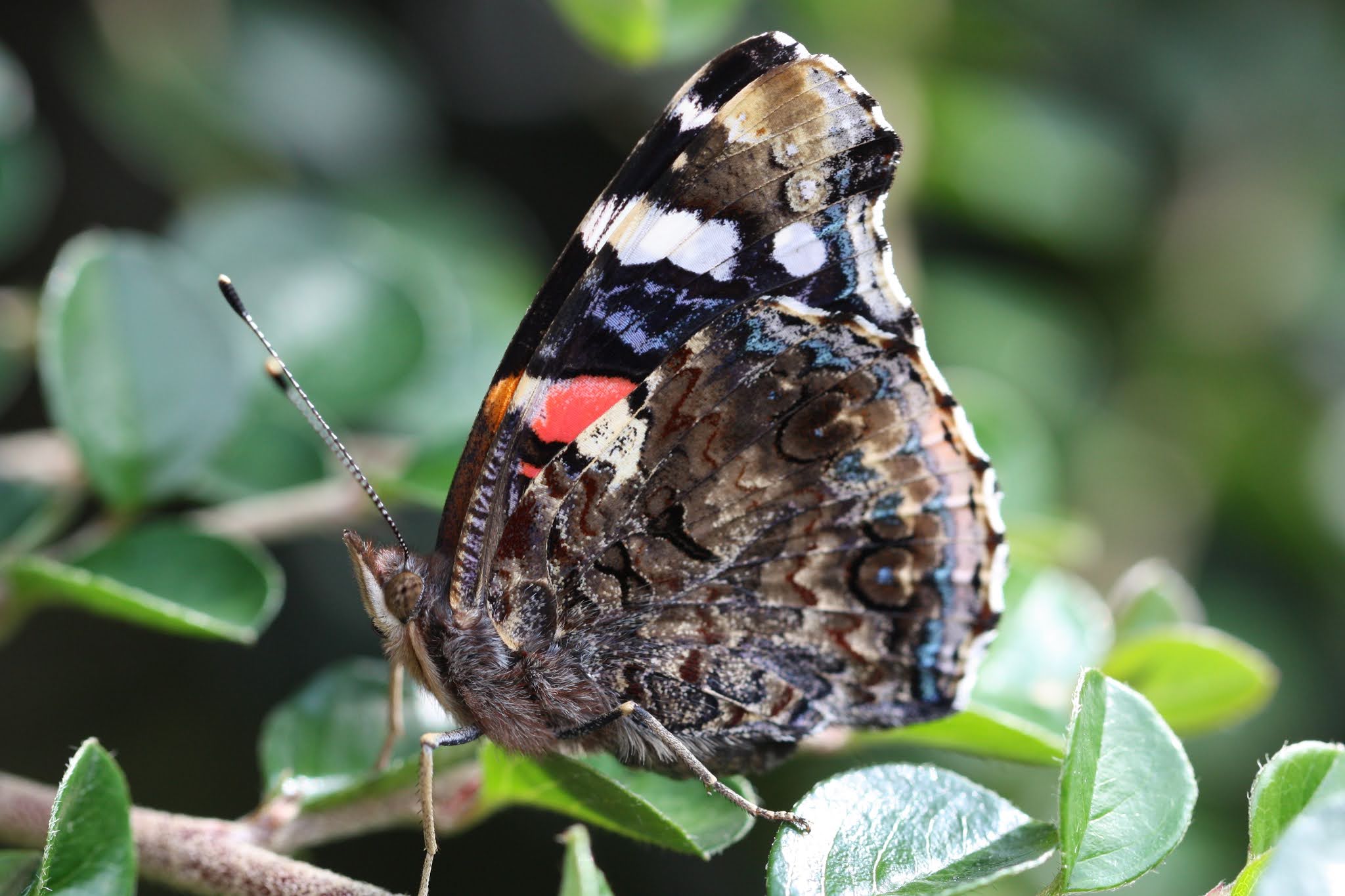
Red Admiral Butterfly.  Size is always relative and its possible to fine a whole universe on the back of the wings of this butterfly that spent minutes on my shirt before allowing close up macro images to be taken.

I’ve tried to pick out a few images which reflect my close viewing of late and include them here on the blog.

Comma Butterfly.  The only one I've seen this year in the garden.


Nice lighting helps me get close up and artistic.

I became an avid reader years ago, but poetry until recent times was never a passion of mine, and much contemporary poetry still leaves me cold.  However, we all change in time and poetry is now very much on my agenda, and you may have noticed John Clare features occasionally on this blog and much of his work was with me throughout lockdown.  I am widening my scope and currently reading works by Robert Frost another great poet and very much into nature.  In some respects, lockdown did me a favour.  The great poets that have written about nature clearly studied what they saw at length and learnt a great deal from doing so, and any naturalist or budding naturalist can learn a great deal from that and the work of poets and other nature writers.  Nothing however can replace your own graft in the field.

Red Admiral Butterfly

Thursday, 16 July 2020

Lindisfarne Quest

Elvis Costello sang of it being a good year for the roses, well in my opinion 2020 with all its problems so far has if nothing else, been a good year for the orchids.  Sam and I had decided that today was right to involve ourselves in a quest on the holy island of Lindisfarne.  It was to be a quest in search of Epipactis sancta, more commonly known as Lindisfarne Helleborine.  We hoped also to find along the way other wildflowers, including another of the genus Epipactis, the attractive Marsh Helleborine.

The tower and house on the Snook

We knew we could not take a sighting of the Lindisfarne Helleborine for granted even though we had timed our journey to hit its peak flowering time.  After all, there are very few specimens of this plant on the island, its flowering time is short and weather can affect the timing of this.  On the plus side we had time, enthusiasm and dedication.
We joined the string of vehicles crossing the causeway before 1:00pm, and judging by this traffic it seemed that the centre of the island was going to be heaving with visitors, modern day pilgrims I suppose.  Thankfully, we weren’t going to the centre, but rather our quest was to the western end of the Snook.  Often, we drive past this area in winter and head for our usual birdwatching haunts, when usually the island is less frequented by people. Although in any event, we find that most folk venture little further than the village and the castle.  I would say at this point, it is only by exploring the more remote areas of the island that you can claim to really know it.

With car parked on the Snook we ate some lunch whilst I thought of holy men illuminating books, Viking marauders, lime burners, farmers and fishermen.  It was dry and mild, but overcast with cloud which was to occasionally break during our time here and give wonderful lighting conditions and at times keeping us very warm.
Sometime after leaving the car we looked up to find that we had been so engrossed in identifying plants such as Sea Arrowgrass, Sea Plantain and Seaside Centaury that we had barely left the carpark.  We continued our walk westwards.

Sea Arrow Grass

Sea Plantain

Seaside Centaury.

Various Orchid species were soon showing well, Common Spotted, Northern Marsh, Pyramidal and then Marsh Helleborines in numbers and then we found the elusive Lindisfarne Helleborine.  Our quest had been successful and we could now relax and just enjoy all before us.

Pyramidal Orchid.  The best of many seen, growing in shelter of what appeared to be old World War Two defence structure.  Wonderfully lit, but I have not quite captured the beauty that I saw on the day.

One of many Northern Marsh Orchids, and many were in much better condition but by now my mind was on Helleborines.

Common Spotted Orchid

The Lindisfarne Helleborine was first recorded on the island in 1958 and at that time believed to be Epipactis dunensis, the Dune Helleborine.  It wasn’t until the turn of the current century that it was recognised as a species in its own right, and by some that it had even evolved separately from Dune Helleborine and its variety Tyne Helleborine.  Lindisfarne Helleborine is therefore endemic to the island.  In beauty it is not up to the standards of the Marsh Helleborine of which we found many, but it is always nice to see a rarity.  Nice also, was the chance to point out the plant to a friendly couple who we had got speaking to about other orchids.  Having left the carpark, all the other folk seen in the distance could be counted on one hand, so we had no problem with social distancing.

Marsh Helleborine

Marsh Helleborine

Marsh Helleborine

We didn’t ignore the butterflies and by now we had seen Small White, Common Blue, Small Heath, Meadow Brown and Dark Green Fritillary.  Bird watching today had no priority, but we did hear Sandwich Tern and see the likes of Kestrel and Meadow Pipit.  As I was sitting in the Dunes and picking off numerous heads of that damn invasive Pirri-pirri Bur we heard fly overhead what sounded very like a Bee-eater!  We didn’t see the bird so it will be one of those ‘’we’ll never know moments’’ but we have seen and heard many Bee-eaters on our travels in Europe and I trust Sam’s hearing skills,  if not my own at times.

Lindisfarne Helleborine

Lindisfarne Helleborine.  Not the most beautiful of orchids, but rare and interesting.

Walking further into the dunes we were well rewarded with plant species including the small Fairy Flax and the much large Vipers Bugloss.   We listened to the distant haunting calls of Grey Seals, and on our return saw many hundred laid out on the sands to the south of the island.

Fairy Flax

Viper's Bugloss

Looking out onto the long stretch of isolated sand it was obvious none of the crowds visiting the centre of the island were venturing far.  We saw only two people walking like matchstick men and women close to the sea in the far distance, otherwise it was completely deserted of humankind.

Deserted Sands

Purple-Milk Vetch

Thinking that there may be plants on the edge of the dune area where it meets the sand, on our return  we walked along this edge but found only grasses  and the stump of a tree, showing a face, partially carved we thought by human hand.


Self Heal

Silverweed

Eventually back at the car I struggled with the Pirri-pirri again, eventually finished off the remains of my lunch and we left the island to the masses and travelled south.
We made a stop at Bamburgh where we visited the grave of the Northumbrian naturalist and artist Prideaux John Selby.  Its rather lost and weathered next to the grand, rather over ornate Victorian memorial to Grace Darling.  I wonder how many tourists think she is buried here rather than some yards away.  The Victorians didn’t get everything correct, having built the original memorial in Portland stone it soon weathered and had to be replaced by a new one built with Northumbrian Stone.

Eyebright

Meadowsweet

A second stop was made at Monk House pool where we recorded Common Sandpiper and saw Sea Campion, Harebelll and Meadow Cranesbill.  After a quick third stop at Sea Houses where the smell of fish and chips were enticing, but the queues were not, we set off for home having enjoyed a great day botanising.  Whilst talking of war poets we passed a nice grouping of Red Poppies which seemed appropriate.  Our quest was complete.

(All images taken on the Snook, Lindisfarne.  Remember to click on them to up-size)

Thursday, 9 July 2020

Wingate Quarry and Thrislington. Butterflies and Botany.

The pull of another trip south of the Tyne was too much to resist, and our efforts today were well rewarded.

Giant Bellflower at Wingate

Wingate Quarry was our first stop on what was a breezy morning with a chill in the air, grey cloud at times threatening rain which never arrived in any noticeable amount.   The first highlight of the day was finding a rather noisy begging family of unfledged Kestrels being fed by a parent bird high and safe on the quarry face.  The young Kestrels looked almost ready for flight and they were making moves outside of the nesting area.  After this encounter our minds were firmly on butterflies and botany for the rest of the day.  At this point we had no idea just how well the day was to turn out.

Like the old quarry at Bishop Middleham, this area had been worked for magnesian limestone until the 1930s.  We were here primarily to try and find Marbled White Butterflies, rarely seen in the area outside of the reserve, they were introduced here in 2000.  Initially we struggled to find any butterflies of any description in the overcast conditions, then one or two species began to make an appearance, all of them flighty.  Then we found one Marbled White Butterfly, and moving on to an area rich in knapweed and thistles more were seen, but again all where flighty and viewing chances where brief, with no chance of a photograph.  They would quickly disappear as soon as the sun was covered by cloud, seemingly disappearing deep into the grasses.  There were other butterflies too including Small Tortoiseshell, Common Blue, Meadow Brown, Ringlet and Small Skipper.

Small Tortoiseshell Butterfly.  The under-wings are often as interesting as the upper-wing.

Common Blue Butterfly (male)

A single Fragrant Orchid, a single Common Twayblade and many Common Spotted Orchids stood out from among some interesting flora.  Having looked again at my image of the Common Twayblade I see in the flowers, celebrating spacemen/women in green spacesuits, and honestly I have not touched a drop of red wine today.   This had been our first ever visit to Wingate Quarry, I’m sure it won’t be our last.  Our next stop was to be a first visit too, the reserve at Thrislington, a National Nature Reserve.

Common Twayblade

Small Skipper

Small Skipper

During our hours walking at Thrislington we learned a good deal about this calcareous grassland area, not least being its sheer beauty at this time of year.  There are hectares of land painted in patchwork fashion by the vivid colours of a myriad of wildflowers.  The scene could have come straight from an artist’s brush and palette and offered ample opportunity for the poetic mind.

purple Betony

Betony

With so many flowers came numerous bees, grasshoppers, butterflies and other insects.  The star butterflies were the Northern Brown Argus, which we had expected, and the Dark Green Fritillary which we hadn’t really thought about.  Both species probably reaching double figures.  Again, the Dark Green Fritillaries were especially flighty, but one, sadly a little worse for wear, gave the chance of a photograph.

Northern Brown Argus

Northern Brown Argus

Dark Green Fritillary

By now the sun was out and warming the air.  The day list of butterfly species seen came to 12 and some others added included a lone Small White as we stepped from the car, Small Heath, Red Admiral and Speckled Wood.

As we walked through the grassland we found the air strongly scented by the many plants that bloomed and encircled us.  Perhaps the most noticeable scent came from the many beautiful Fragrant Orchids now reaching their peak of perfection.  There were thousands of orchids of many hues and sizes, but orchid species which stood out for me was the Dark Red Helleborine which we eventually came across.  This must rank highly on my list of favourite flowers and they had reached their peak, one of them holding 36, wine red flowers on its spike.    This made up for our disappointment on visiting Bishop Middleham Old Quarry a couple of weeks ago and finding only one of these plants beginning to flower.

Fragrant Orchid

Fragrant Orchid

It was with interest that I noted from Anne and Simon Harrap’s Orchids of Britain and Ireland that the first British record of Dark Red Helleborine was made in a work by John Ray in 1677.  The site Ray mentions is Malham, 4 miles from Settle.  Also noted in Harrap’s book is that the maximum number of flowers known on a Dark Red Helleborine plant is 45, so our plant wasn’t far short of that.  My own experience of seeing these orchids is that spikes usually have fewer flowers.

Dark Red Helleborine

Dark Red Helleborine

I have never seen such a display of Orchids, nor can I recall seeing such an area of general botanical interest in Britain.  It had us discussing just how wonderful it must have been to wander around the open country of John Clare’s England and enjoy not only the sight, but also the aroma of wildflowers.  Oh, how he would have enjoyed today's walk.

We recalled the flower meadows of Eastern Europe and the area where open grassland met the tree line even invoked memories of the African Savannah, although on a minor scale of course.  Yellowhammers sang as we admired the scene.

Savannah type scene

Sam ready for action

There were simply too many species of plant to list, but some come instantly to my memory.  Carpets of golden Rock Rose, large areas of purple Betony, layers of Agrimony, bee laden Greater Knapweed, pale blue Field and Small Scabious side by side, masses of Birds foot Trefoil, clovers and vetchlings, blue Perennial Flax, Common Centaury, delicate Common Milkwort and an abundance of Lady’s Bedstraw and many  more.  It may sound imaginary and overstated, but it is not.

Perrenial Flax

Common Milkwort

We chatted to the chap from natural England who was going about his business and tetrads and was one of the very few people we saw in the area, and he give us a condensed history of the reserve.   Exmoor or similar Ponies are used here in winter for conservation reasons and whist some of the area is perfectly natural, a large proportion was re-laid some years ago.  To my untrained eye I would not have known.  As with any conservation area it is not without its problems and conflicting views as to how best to manage it, but whatever is being done certainly seems to be working.

Rest Harrow

Kidney Vetch

It’s quite a walk to do this area justice, but there was so much interest, we quite forgot how far we had gone, although the whole day here would not have been wasted.  Our day had been wonderfully complete and it had been a good lesson in botany.  We’d quite forgotten about birds and decided that tiredness meant we ought to put off a visit to Castle Lake until another day.  Our find of Dark Red Helleborine also meant that a visit to Bishop Middleham Old Quarry wasn’t essential either.

Scabious

Agrimony

Well there is always another time.

busy Bumblebee

Plantain sp

Quite incidentally I’ have begun in the past few days to read a book by Steve Nicholls entitled Flowers of the Field, A Secret History of Meadow Moor and Wood.  A wonderful follow up to the trip described and full of excellent photographs.  I believe Steve is a Middlesbrough guy so I’ll be checking to see if Thrislington gets a mention in his book.  By the look of the index it doesn’t.

Addendum.

Please remember when visiting reserves or other areas of this nature, to keep to the pathways.