Tuesday, 19 January 2021

On Patch & the ''No Idea Tree''

 All day and night, save winter, every weather,
Above the inn, the smithy, and the shop,
The aspens at the cross-roads talk together
Of rain, until their last leaves fall from the top
(From Aspens by Edward Thomas)

The almost blinding bright lemon sunlight enticed me out onto patch and I had the intention of walking to the lake then onwards to the village.  Before I got to the lake I realised that the sunlight gave a misleading suggestion of warmth, as the air was bitterly cold and the paths in part covered in thin black ice.  A fellow walker mentioned as we passed one another that there were two Water Rails at the side of the smaller lake.  This species is only a very occasional visitor to patch so I stepped out.  It was not one to miss. 

I hung around the smaller lake for an hour and a half, the cold eventually seeping through my layers.  I thought at one point that I has spotted the rails in the reeds, but distance, position and light combined to make me uncertain.  My plan to walk further came to nothing although on the positive side I did meet two or three old friends I had not seen for some time and so enjoyed a chat.  No one was picking up Water Rails.  I kept on the move partly to keep at least some warmth and partly to give different angles of view.  I did notice that now the lakes had become unfrozen the numbers of Goosanders had increased, but there were still fewer birds about than would be expected at this time of year.  I decided to give up and make home for a hot drink.  I took one last look, and low and behold, had a decent sighting of Water Rail walking out in the open before disappearing into the reeds again.  I decided that one Water Rail was enough and made for home.  I remembered the Water Rail I found in Jesmond Dene some years ago in the height of a very cold winter.  It was the first one recorded in the dene for almost 100 years!

My next trip out (lockdown will ensure that the patch sees more of me than usual) was made to the area surrounding the village, which I had intended to visit previously.  It was much milder today and the area was waterlogged.  I negotiated pools of water and a pathway which had changed to a running stream, but sadly saw extraordinarily little in the way of birds.  Conditions ensured I had the place to myself and I felt better for the walk as I took in the view across the fields in changing winter light and passing cloud formations.  I did find three sapling Horse Chestnut Trees in a line of hedge after I had carefully watched a Mistle Thrush slowly and methodically searching an area of the field.

Ladybirds on gravestone

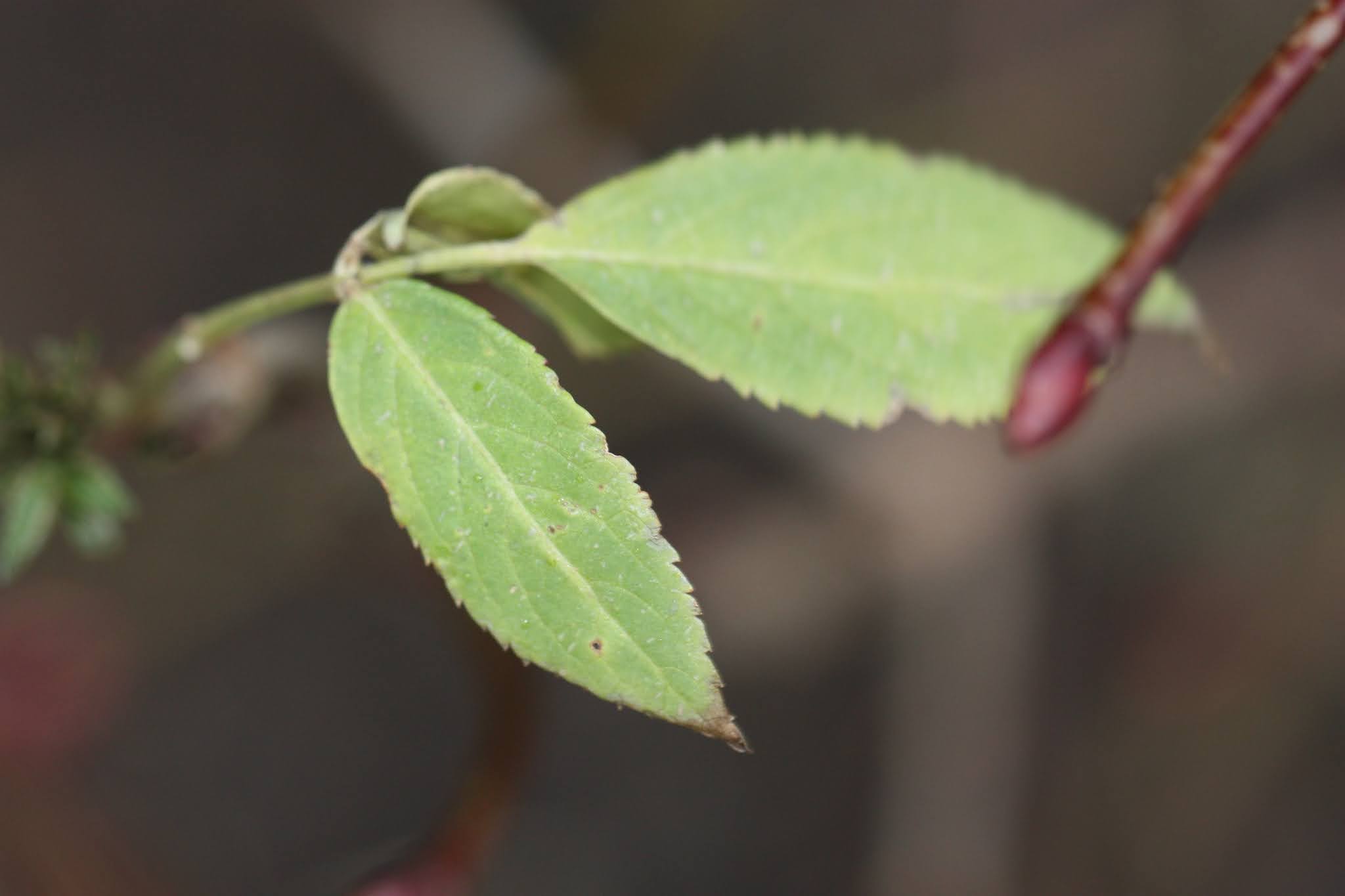
Today, another milder, but rather grey day, I met up with Sam and we slowly wandered patch for two and a half hours.  In the main it was trees we were looking for so we began in the church grounds.  There is a Yew and an Irish Yew in there which are always worth checking out for Goldcrest.  There were once again few birds at all today.  I had not previously taken in the numbers of European Aspen growing here and several that appear to be self-setting Aspens are on the outside of the grounds too.  The root of one of the older trees was growing along and into the wall resulting in some substantial damage.  I was reminded of the poem of Edward Thomas, Aspens.  Perhaps not so surprisingly because Aspen are a food source for Ladybirds, Sam got his eye on a cluster of hibernating Ladybirds on the under-edge of a gravestone.

Aspen Bark showing lenticels

I have taken quite an interest in the European Aspen Populus tremula.  On the bark of the tree, diamond shaped lenticels function as pores which allow for the passage of gasses between tree and atmosphere.   The shape of lenticels is one of the characteristics used for the identification of species of tree e.g., the dark horizontal lines on birch are lenticels.  Aspens will often produce clones of themselves by root sprouts that can appear up to 40m away from the parent tree.  If the parent tree dies these clones can still be produced many years afterwards.

Wild Cherry Bark

World War One twin military grave.  One of those identified is probably buried in an unknown area of the grave yard.

We identified many species of tree as we continued our walk including several Horse Chestnut and later at least two Sweet (Spanish) Chestnut.  The name Spanish derives from the fact not that the trees are of Spanish origin, but because the deep swirling bark markings are mindful of flamenco dancers.  We were wondering if the Spanish Chestnuts could have been part of the Avenue of trees which once led from Killingworth House which was demolished in the 1950s.  More research required here I think.  The three trees that Sam confirmed were part of the Avenue are the large old Beech, Horse Chestnut and Sycamore in what is now parkland.

'Sticky' bud of Horse Chestnut.

Bark of Sweet Chestnut

I enjoyed my time spent on tree identification.  Every now and again I would get a reply from Sam along the lines ‘no idea’ when I asked about species, hence the title of the blog.  We are both out to learn, although I have some catching up to do.

Old Lime (prob small leaved)

Early showing of Lime leaf  on  18th January

Not so many birds were seen, but my bird of the day was a male Bullfinch giving an exotic look in the diminishing light.  I had hoped for a song from Bullfinch today but we only heard short calling notes.  The next few weeks are a good time to listen for the melancholic Bullfinch song, however.   The same Mistle Thrush (recognised by obvious markings) was still feeding in the same spot as it had been the other day)

Macro image of moss sp.

Today I am pleased to see that the Song Thrush missing for a few days has returned to my garden, along with a few other species including numbers of House Sparrows which I missed when they deserted the area for a time

Friday, 1 January 2021

New Year's Day

Before heading down to the lake with my first foot Sam, I watched a garden which has been quiet for some time.  First three birds seen were Blue Tit, Blackbird and Song Thrush.  The female Blackbird appears to think that the garden is her territory by right and behaves extremely aggressively towards any other bird, especially the Song Thrush.


Thawing Lake

We found the lake largely ice free, however I think numbers of birds had left, the lake having been frozen in recent days.  The sun was still quite low in the sky and the thawing smaller lake was a sun glade in places, and the numerous gulls formed a nice picture on the thinning ice.  To the west and far end of the larger lake a bright rainbow also painted a colourful picture in the dimmer light.  I could not help but think of the numerous rainbow pictures I have seen in people’s windows in the last months.  The larger lake held its usual birds, but fewer of them, only one male Pochard and one female Goosander.  The Goosander and male Goldeneye were lit by the sun and the latter bird especially, looked stunning with golden eyes and plumage showing so well, and was to remain my bird sighting of the day.


After walking to the far end of the large lake we doubled back and walked through the small woodland area where we found the likes of Redwings, Long Tailed Tit, Blue Tit, Great Tit, Bullfinch and Goldfinch.  We chatted to a local birder who was certain that he had seen a Woodcock fly off on his approach.  I must say the area looked ideal for that species.  Passing the small lake again we sighted Grey Heron.

Later the church grounds gave us nice sightings of Treecreeper and Great Spotted Woodpecker and it was good to hear drumming on the first day of the year.  We began more closely to study the trees more closely from here on.  As far as I am concerned 2021 is to be the year of the tree, the year that I get to grips with a wider knowledge of tree species.  I think many Killingworth folk would be surprised at how many species of tree there are in the area.  Sadly, there are many who would not be interested.


Harvestman Spider on Oak

We wandered around the area at the back of the village and had a long chat to a couple about various places of interest that we had all visited or would like to visit.  By now, despite a small shower the air felt much milder than of late.  There were more Bullfinches here along with Chaffinch, Greenfinch, tits and the ever-present numbers of Magpies.  Despite numbers of Carrion Crow and Jackdaw we found very few Rooks today.  Unfortunately, the once thriving rookery in the village is far smaller now.  When I first moved to the area I used to watch this rookery with interest, but that seems such a long time ago now.  Nuthatch was heard and seen briefly and we took some time looking at the lichens growing on the trees.


Lichens

We ended our walk in the small parkland, once part of the demolished Killingworth Hall.  The birding highlight here were the Siskins.   More of our time was spent examining the trees and chatting to passers-by about them.  There are some notable Northumbrian trees here not least being the old Beech Tree, the old hollow Sycamore and the Horse Chestnut Tree with its sticky buds.  Why are they sticky I am wondering?  Everything is for a purpose and I am guessing this stickiness has evolved as some kind of protection.  Whatever, I have decided I like sticky buds.  As Sam says, this time of year is a difficult time begin to learn about trees, but I like a challenge and with Sam’s help I hope to make advances.  Botany in general is to be a focus this year.  I am far less inclined these days to be focussed solely on birding as there is so much more to take note of and investigate.  I have never been a twitcher and this past year have not even kept my usual annual list, but continue to find reward from my general interest in the natural world and related history.

Sam and the old Beech Tree

Aged hollow Sycamore

We said our goodbyes at the park and made for home after a very enjoyable four hours.  I thought about the history of this area and how much it has changed.  How many pitmen, farmers and other labourers have in the past taken the same route as I was taking along what is a pathway with a long history.  What was a nature trail when I first moved here has now been largely destroyed by the insistence of residents to remove hedging and even trees, often outside of there land, and replace these with the likes of ugly wooden fences.  Is there some hope that humankind will ever learn to live with the nature surrounding us rather than attempting to rule it and destroy it?  I do not want to be pessimistic at the beginning of a new year, so I would like to think that one day nature will be appreciated by all.  Happy New Year and may, 2021 be an improvement on the year that has just passed. 

Wednesday, 2 December 2020

Beginning Winter in the Breamish Valley

The 1st of December and the meteorological beginning of winter found us in the Breamish Valley.  The river Breamish is one of eight rivers that rise in the Cheviots, The Breamish becoming the River Till near Wooler.  This is a tributary of The River Tweed and the only one that flows exclusively in England.  Today we were here as much for the landscape and habitat as much as for the bird life.

All of us interested in the natural world reach that interest along differing pathways and at different periods of our lives, and how and when this occurs depends very much upon opportunities open to us.  Along with many others my passion for nature did not ignite during my early years, but nevertheless I consider that passion equal to most.  My real interest was ignited not by direct experience or helpful support of a more experienced friend, but rather by three particular TV series that were broadcast in the 1970s to early 1980s.  These were David Attenborough’s Life on Earth, The Voyage of the Beagle and a local programme which featured naturalist and artist James Alder and a gentleman of the name of Ian Armstrong.  Local naturalists will need no introduction to James Alder, but may not be so aware of Ian Armstrong.  Ian worked for the RSPB and was given the role of raising the profile of the organisation in the North east of England.  He became the first leader of the Local RSPB Group in 1969, a role I filled for a few years at a much later date.  Both James and Ian were good communicators (I have found over the years that many knowledgeable folk are not good at communicating) and always happy to share their knowledge of the natural world, a character trait I have always rated highly in any naturalist and I was pleased to have later known both men, if only in passing.  The programme which these two-gentleman presented which had such an effect upon me was made in the Breamish Valley and introduced me to both Dipper and Nuthatch.   I had never seen either bird in the wild.  Today I was hoping to find both species and I could not help feeling that James and Ian were with us, if only in spirit.


River Breamish

After a brief stop at the bridge at Ingram we drove further into the valley and then walked a stretch of the river.  Temperatures were low and it was a typical early winter scene with much of the colour around us being of pastel hues of purple, ochre and sienna, often broken by the varying greens of coniferous trees and the golden colour of the still flowering pockets of gorse.  The banks of the river held many Alders and the occasional aged and twisted Hawthorn.  Above us on the hillside was a large area of Silver Birch, a species of tree that is a favourite of mine.  A party of Blackbirds fed gluttonously upon the bright red berries of a lone Mountain Ash, high on the hillside.  Despite the glut of berries still apparent, there seemed still to be the usual competition seen within this species.  A Mistle Thrush called, a Common Buzzard flew slowly but powerfully along by the ridge of the hills and pairs of Kestrel were spotted on several occasions.  Fieldfare flew back and forth across the valley in small flocks and a single Redwing was recorded, as was a single unmistakeable Jay and Great Spotted Woodpecker in buoyant flight.  Pheasants were heard and occasionally seen, one of which perched camouflaged high in a tree at the road edge.  Carrion Crows were plentiful and small numbers of Wood Pigeon flew high across the valley.


Silver Birches

With little to no wind, at times the valley was silent apart from the sound of the waters of the Breamish as it made its way down the valley passing over the rocks and pebbles of varying size and shape.  A sun glade appeared from time to time on surface of the waters which at times reflected a dark grey hue, at other times a bright ultramarine, depending upon the state of the ever-changing cloud cover and angle of view.


Dipper

As we continued our walk Woodcock lifted and flew low and away from our path, landing some distance away from us.  It wasn’t long before we heard the call of Dippers flying up and down the river and soon afterwards we had good sightings of these birds, two pairs in fact.  Each bird very conscious of our presence, but despite this we were able to enjoy the high-pitched melodic song from individual birds of each pair.  Both the male and female are known to sing and will on occasions sing whilst in flight.  A song often underrated and perhaps even more often missed altogether by the less sensitive ear. Without any attempt at a careful search we found four used Dipper nests and I watched as one of the birds inspected one of these.  With hindsight and knowing Dippers will often build more than one nest at breeding time, I’m thinking that one or two of these nests may have been started, but unfinished.  The nest is often built directly over water and the young birds may evade predation by dropping from the nest onto the water even before they have developed flight.  In the case of the nests we saw perhaps the youngsters would be safer remaining put as beneath the nest was solid concrete.   Being early breeders, hopefully these pairs will have fledged young before the end of winter.  I suspect however, along with the other birds of the valley they will have hard wintry conditions to endure beforehand.  Having watched the Dippers at some length we retraced our steps and drove back to Ingram to view the church and hopefully find Nuthatch.

As we sat in the car eating lunch we watched an acrobatic Red Squirrel in the trees ahead of us, a species not seen in Northumberland by either one of us for quite some time.  Having had our fill of both lunch and Red Squirrel we walked through the silent woodland to the church.  A small patch of Herb Robert and Red Campion provided small amounts of colour under the shadows of the trees.  There has been a church at this site since before the Norman Conquest.  In medieval times this building was of grand appearance.  However as hard times hit the area the local population dismantled large parts of the church, being unable to afford the upkeep.  Eventually there was much deterioration until a rector and his sister during the Victorian Period ensured that what is more or less the present church, was built.  The rector’s wife and two children had been killed in an accident whilst in southern England, the children on their way to a private school.  The rector ensured that the church was restored in their memory.  The church grounds have a war grave of a local 23-year-old Coldstream Guardsman, killed in the Second World War.

We returned via the dark atmospheric woodland and the river to find that the Ash copse now held numbers of birds.  This included Nuthatch which we heard, but never did see.  A feeding mixed flock of birds appeared to have arrived, most numerous were the Long-Tailed Tits which were continually active.  Also present were Chaffinch, Blue Tit, Cole Tit, Great Tit and Treecreeper.  A Bullfinch was also heard.  Sadly, should Ash Die Back hit this copse it will be decimated.
We returned to the car to find a Robin which showed no timidity at all and after taking some close up images of it I was able to feed it from my hand and it seemed to appreciate the currants from a piece of fruit loaf.  I am thinking this Robin has been accustomed to being fed by visitors.  After having its fill, it flew into the nearby tree and began to quietly enter into quiet melodic song.  It would be over sentimental to suggest it was offering thanks.  A Grey Heron flew overhead.

By now the skyscape was a mix of azure, streaked by white cloud.  The skyscape continued to give dramatic effect above an equally dramatic landscape as we drove home via Rothbury.

My thanks go to Sam for providing the usual great companionship and on this occasion help with tree identification, something I must give attention to.  Thanks too to James and Ian for the inspiration given all those years ago.  The Dipper continues to be among my favourite bird species.  The natural world has taken a beating in the intervening years, but whilst areas like the Breamish Valley continue to exist there is hope.


Wednesday, 25 November 2020

Exploring Northumberland

Bothal Castle

 The weather forecast was none too good as we initially set of for the village of Bothal, possibly often on the itinerary of birdwatchers because of the pool nearby.  Our trip was in the main a none birding outing and because of the weather I was hoping maybe for some Turneresque skies to enhance some landscape photography.  It was appropriate then, that our first stop was at Bothal as this was on J M W Turner’s schedule of visits on his tour of Northern England in 1797.  Turner, the greatest of British artists in my view, was only twenty-two at the time.  His sketches of Bothal, the castle and church remain very recognisable today, although the houses of today are a great deal more up-market and no doubt expensive.  Turner depicts a horse and rider in the sketch of the castle, and coincidently a horse with rider came along the road today.

Bothal Church

The castle, a private residence, has a long history and having taken some photographs of it we took a walk in the Church grounds where bird finds included several Nuthatches and Mistle Thrushes, both species calling loudly.  The Mistle Thrush’s vernacular name of Storm Cock proved appropriate today, as you will later find.

Bothal Church

Bothal Church Grounds

Much of the present church is between 600 and 800 years old.  Inside, which because of Corvid we were unable to enter, holds fragments of an Anglo-Saxon cross suggesting a much earlier church on the site.  Of course, as to be expected there are Victorian additions.  The doorway has a carved inscription reading WH 1578.  We must return in the future when access can be gained to see medieval stained glass, but we did take note of the medieval stone coffins outside.  The graveyard was very natural and contained many trees of age.  The war memorial outside the front of the church is flanked by weeping Ash and Japanese Maple.  The Ash representing the tears of the bereaved and the Maple which turns bright red in autumn, symbolising the blood of the fallen.

 As we left we passed Bothal Pond and a quick look as we drove brought only sighting of two Mute Swans.  Our next stop was to be Swarland.

On route to Swarland we passed Davison’s Obelisk built in 1807 in memory of Horatio Nelson at the bequest of Alexander Davison, a friend of Horatio Nelson who he first met at Quebec, Canada.  Davison became Prize Agent responsible for the sale of French ships taken at the Battle of the Nile.  At Swarland we looked over the Parkland of what had been the estate of Alexander Davison who had planted groups of trees to represent ships of the British Navy at The Battle of the Nile.  Only four of these groups are now still extant, one group being close to the road.  The line of the road represents the line of French Ships.

Nelson Memorial

We next made north to Edlingham Church and Castle.  The weather began to close in and on arrival at the small parking area by St John the Baptist Church, the rain became heavier until we were amidst a heavy squall.  The sky became a  mix of leaden grey cloud and mist as the light faded.  We admired the church in these gloomy conditions whilst we chatted and ate lunch in the security of the car.

Edlingham Church

Once the rain eased somewhat I decided to venture out and photograph the church.  The gloominess did not appear to be disappearing until suddenly there was signs the darkness lifting.


Edlingham Church

The earliest church on this site dates to around 740AD, although the first stone church dates to the 11th Century.  Fragments of this Saxon church can be found in the lintels of the door.  Much of the remainder is 12th Century and the tower was added probably for defensive reasons around the early 14th Century.  Narrow slit windows could be used by archers.  It is thought that the church was used in the 17th Century to imprison moss-troopers.

From the church it is a short walk to the castle and the nearby burn, a tributary of the River Aln, is close by.


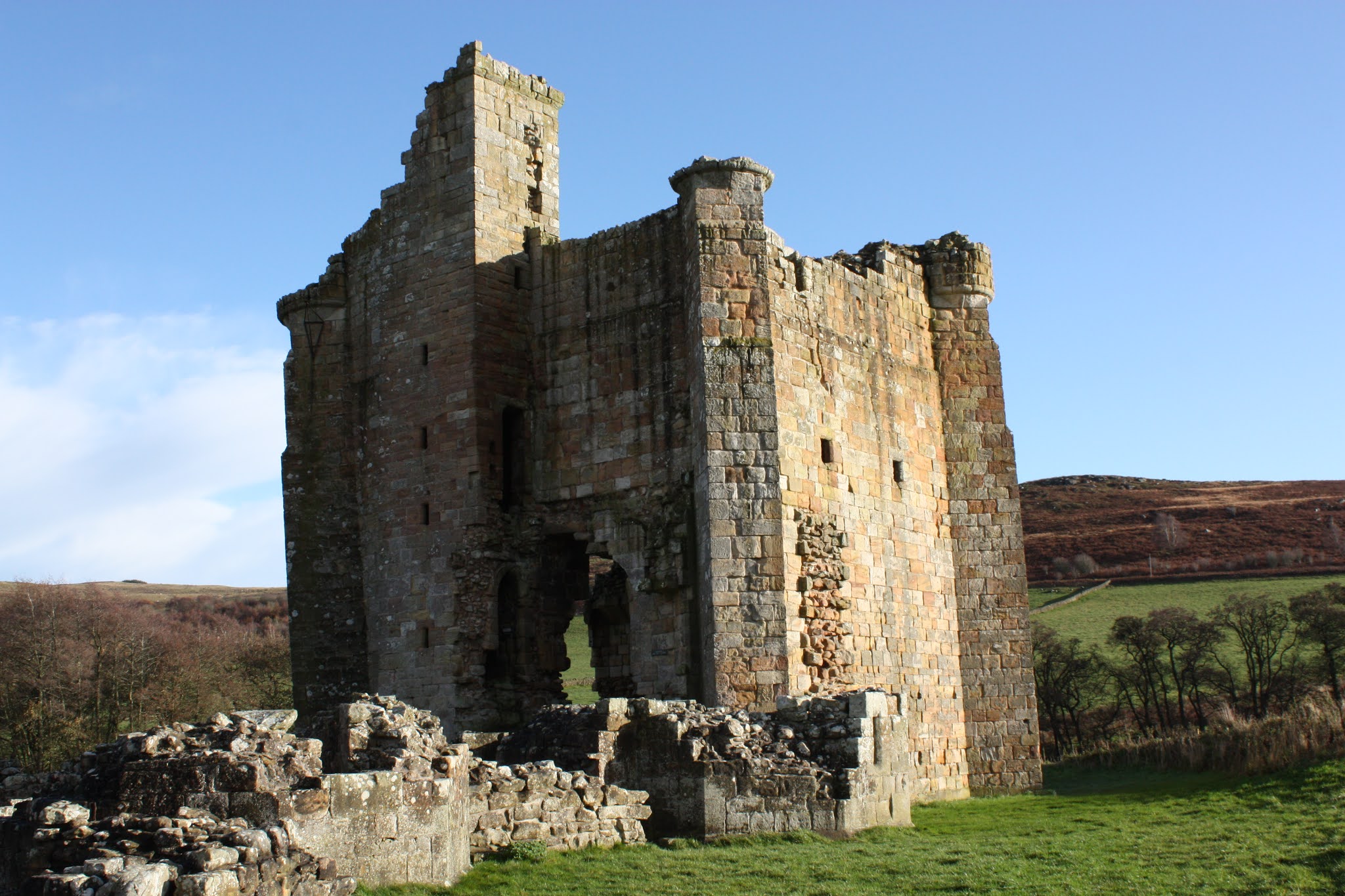
Edlingham Castle

I was extremely impressed by both the church and castle, the latter’s Solar Tower being an especially imposing site.  My mind retuned to Turner and I could not help feeling that the painter missed a trick in not visiting this site on his trip north.  The tower dates from the 15th Century but other structures are from an earlier date.


Edlingham Castle


Our first sighting of the castle at close range was in the dullness of the recently ceased storm, but as time passed beams of light began to lighten up the outer walls and it wasn’t long before light cloud was dissipating and we were under cerulean skies.   As we had approached the castle the roosting Jackdaws had been disturbed and they appeared to make a noisy retreat to trees nearby and did not return until we left.  We’d had the remains of this imposing castle all to ourselves and we had the privilege of viewing both castle and church in varying moods and weather conditions.  I began to imagine the joys, celebrations, sadness and bloody violence this site had witnessed over the centuries.


Edlingham Castle

Deciding that a visit to the nearby Viaduct can be made at a later date, we drove a little way up the road for the views across the verdant fields toward The Cheviots.  As we took photographs a Common Buzzard flew north of us as corvids mobbed it, and its mewing call seemed to reflect a solemn mood.

The mood changes

We took a long detour on our return home and passed the road to Clennell Hall (the family home of Luke Clennell, an apprentice of Thomas Bewick and Bewick’s principal assistant on The History of British Birds).  He later became an artist in his own right, moved to London, suffered mental illness and died in an asylum in Newcastle in 1840) and Alwinton.  Along the way we had sightings of many Redwing and Fieldfare, and Kestrels.  As we drove along the Coquet valley we followed the serpentine movement of the bright silvery river, now lit by bright sunlight.  The day had certainly been one of multiple moods. 

Towards the Cheviots

Addendum.  If willing to pay a not unsubstantial amount, Turner’s drawings and paintings following his tour north can been seen in David Hill’s Turner in the North.  Possibly cheaper to visit the Tate Gallery in London and see Turner’s paintings there.  I’m pleased I purchased my copy years ago at a reasonable price when first published!

The storm has passed.

Anyone who reads this blog on a regular basis (I hope someone does), will know I have fondness for the poetry of John Clare.  I have noted that Turner visited Stamford on his return journey south, the town close by Clare’s village of Helpston.  Clare would have been four years of age at the time, so there will have been no meeting of the two.  However, both I am sure would in later years have become very much aware of one another.  John Clare was introduced as a boy to poetry by James Thompson’s poem The Seasons.  His copy of the poem was purchased at Stamford I believe.  It is interesting to note that Turner too was inspired by the same poem.  I must research into whether the two men ever met when Clare made his short visits to London in later years.  The two men could well have had much in common.

Verdant Northumberland


Sunday, 22 November 2020

Five Hawfinches, A Castle and James Audubon

 Unable to find a space to park near the path to the Hawfinches we decided to visit the castle and river area at Mitford before trying again for a space.  The decision was a good one as when we parked up by the church it was clear that there was plenty of birdlife in its grounds.  Birds seen here included Song Thrush Redwing, Mistle Thrush, Blackbird, Robin, Siskin (heard), Nuthatch, Willow/Marsh Tit (?), Blue Tit, Great Tit, Long Tailed Tit, Goldcrest, Great Spotted Woodpecker, corvids and pigeons.

Lots of bird life in the church grounds.

Mitford Castle

We walked the short distance to the river and followed the line of the pathway up to the castle which dates from the 11th century and which was in the main destroyed in the 14th century.  From ground level it is impossible to grasp the area that this castle would once have covered.  Being at the top of the hill gives a much clearer perspective of the castle boundaries and surrounding earthworks.  Whilst examining the area I thought of the many historic foot prints I was following and was remined later that the American bird artist James Audubon was amongst them.  I don’t think I can blame Audubon for leaving the empty beer cans in the cellars of the castle!  We also passed metal stepladders looking rather out of place.  Perhaps the drinkers are also going in for a bit of DIY.   On our arrival at the castle walls numbers of Redwing had risen from the surrounding berries.  The vista from the castle gives a good picture of the variety of trees in the area, sadly having now in the main cast off their autumnal colours.  It was trees we now had on our mind, in particular Hornbeams as we made off to search for the Hawfinches.

Mitford Castle

A castle with a view.

Mitford Castle

As we joined the pathway to the Hornbeams we found a bird equally exciting as any Hawfinch, in the form of a calling Marsh Tit, so rare in Northumberland.  We later had exceptionally good sightings of a pair of Marsh Tits when we returned to the car.  For now, though we were reassured of sightings of Hawfinch by a fellow birder who had just recorded five of them in the line of Hornbeams.  We were not put off by the drizzling rain or the gloomy light which in fact cast a rather enjoyable atmosphere about the area.

The Hawfinches remained elusive for quite some time and I began to wonder if we were to be unlucky.  The trees and hedges were silent.  The eventually one Hawfinch flew over from behind us and gave a good sighting.  Eventually I saw other birds fly in and the single bird was joined by four other Hawfinches.  Eventually we had good sightings of the five birds together as they began to feed on the samaras.  Feeling the seeds hardness gives an idea of the strength of the Hawfinch’s large bill.  The five birds were quick to take off as a hunting Sparrowhawk appeared and flew down the line of Hornbeams before eventually disappearing.  The Sparrowhawk later returned, this time flying away in the opposite direction.  I found it hard to believe that it was as long ago as December 2017 when we had visited this same area to watch Hawfinches.

The Samara which attracts the Hawfinches.

Hornbeams are a rare tree in Northumberland and it seems likely that the extremely hard wood of this species will have been used in the gears of the mills, three of which are known to have existed in this area.  The English name Hornbeam derives from the hardness of the wood (likened to horn), and the Old English beam i.e. tree.

As we left and had our sighting of the pair of Marsh Tits, we read the sign which remined us that the pathway walk along the River Wansbeck has probably changed very little from the time of James Audubon’s visit to Mitford Hall in 1827.  Sam later pointed me in the direction of Audubon’s journal (available on the internet) where he records his visit to Mitford Hall, Mitford Castle and his walk along the bank of the Wansbeck with Captain Mitford.  Audubon had met Captain Mitford, brother in law of John Selby the Northumbrian naturalist and artist, at Twizell House the home of Selby.  The two men travelled together by coach to Morpeth.  Whilst the coach changed horses at Alnwick they visited Alnwick Castle before proceeding on their journey passing Alnmouth.  After his stay at Mitford Hall Audubon travelled to Newcastle which he was none too complimentary about, recording its shabby appearance in comparison to Edinburgh.  Nevertheless, he appears to have enjoyed meeting Thomas Bewick and his family and finding subscribers to his artwork.  I intend to order a copy of the journal as a cursory glance of it on the internet suggests that it holds much of interest, but it is tiresome trying to read it at length on the screen.

Jenny Uglow in her biography of Thomas Bewick records that ‘hearing that Audubon’s sons longed for a copy of (Bewick’s) Quadrupeds, Bewick gave him one at once.’  It is also recorded that Audubon remembered that ‘when I parted from Bewick that night, I parted from a friend.’  Of course, in 1827 Bewick was an old man and he died the following year.  

After we left Mitford we drove to Harewood and passed Winter’s Gibbet which appeared well placed in the now gloomy atmosphere of rain, mist and cold.  We thought it a good idea to photograph the bleakness of the area.  I soon returned to the car for warmth and thought it best to admire the bleakness from my seat.

It was bleak on the moors.

It had been a good day and one were birding was enjoyed along with other interests.  Common Buzzard, Fieldfares and more Redwings were seen along the way.  An interest in ornithology has led us along many paths of interest and I hope this blog will continue to reflect that.  Coming soon will be a report of another interesting trip into Northumberland’s historic sites.